

A subconjunctival hemorrhage is a bright red patch on the white of the eye caused by a tiny ruptured surface capillary. Though alarming in the mirror, if there is no pain, no blurred vision, and no discharge, it behaves like a harmless skin bruise and clears completely in 10-14 days. Recurrent episodes or eye trauma still warrant an ophthalmic check for high blood pressure, blood-thinner excess, or internal injury.
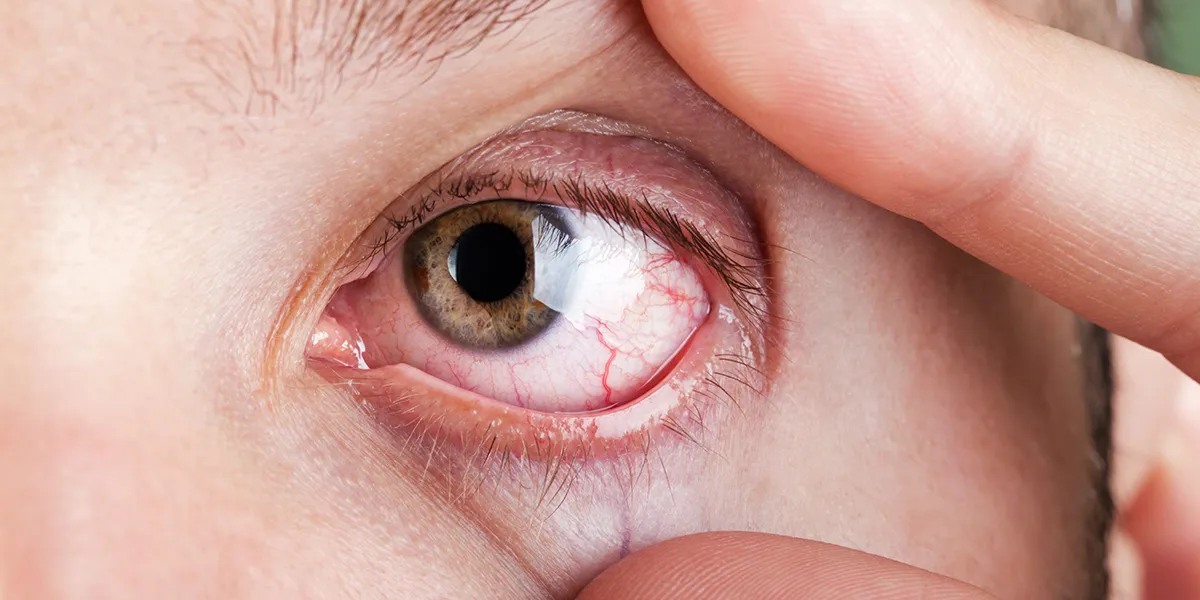
Why a Broken Blood Vessel on the White of the Eye Looks So Dramatic
Hair-thin capillaries sit directly beneath the crystal-clear conjunctiva covering the white sclera. A sudden pressure spike from coughing, sneezing, straining, heavy lifting, eye rubbing, or elevated blood pressure can snap one tiny vessel, spreading a vivid scarlet patch beneath the clear membrane. Exactly like a bruise on your arm, the body naturally reabsorbs the blood over 10-14 days without affecting your vision.
4 Situations Where a Red Eye Is NOT a Harmless Broken Vessel
- Following blunt eye trauma or a fall: Surface blood can hide a deeper scleral injury, internal bleeding (hyphema), or retinal tear.
- Accompanied by pain, light sensitivity, or blurred vision: Simple subconjunctival hemorrhage NEVER blurs vision or hurts, those symptoms point to uveitis, keratitis, or acute glaucoma.
- Repeated episodes over months: Strongly suggests undiagnosed hypertension, diabetes, or excessive anticoagulation (Warfarin/INR).
- Blood pooling across the colored iris: An intraocular hyphema requiring urgent ophthalmic care.
Red-Flag Warning Signs Requiring Urgent Ophthalmology Evaluation
- Red patch after any blow, impact, or eye injury: Needs same-day dilated exam to clear internal ocular structures.
- Pain, blurred vision, photophobia, or yellow-green pus: Rules out simple hemorrhage, seek prompt medical review.
- Recurrent eye bleeds with headache or nose/gum bleeding: Check blood pressure and coagulation/INR immediately.
Diagnostic & Pre-Treatment Imaging Protocol in Antalya
Confirms blood is confined beneath the conjunctiva with a crystal-clear cornea and anterior chamber.
Excludes acute pressure spikes or glaucoma.
Checks the retina whenever impact or injury occurred.
Reviews blood pressure and blood-thinner monitoring safely.
Red Eye Triage Table: Benign Bleed vs Urgent Conditions
| Condition | Appearance | Pain & Vision | Urgency |
|---|---|---|---|
| Subconjunctival Hemorrhage | Sharp-edged bright red patch | Zero pain; 100% clear vision | Check BP; exam if trauma or recurrent |
| Conjunctivitis (Pink Eye) | Diffuse pinkness + discharge/itch | Gritty; vision mostly clear | Exam within 1-2 days |
| Uveitis / HSV Keratitis | Deep red ring around iris | Aching pain + glare + blur | URGENT (Same-day exam) |
| Acute Angle-Closure Glaucoma | Diffuse redness + hazy cornea | Severe pain + headache + nausea | EMERGENCY (Hours matter) |
Patient Journey: 4 Steps from Diagnostics to Recovery
Check Symptoms & BP
Measure blood pressure; seek same-day care if pain, blur, or trauma exists.
Gentle Comfort Only
Preservative-free tears soothe mild scratchiness; avoid vasoconstrictor drops.
Day 4-7 Yellowing
Edges fade yellowish-brown like a healing bruise.
Day 10-14 Full Clear
White sclera returns completely clear with zero lasting mark.
Frequently Asked Clinical Questions
Is there an eye drop that clears a broken blood vessel faster?
I take Aspirin or Warfarin, should I stop my blood thinner?
Is it safe to fly home from Antalya with a painless subconjunctival hemorrhage?
Why did the red spot look slightly larger the next morning?
Can a broken eye blood vessel cause blindness?
When should I see an ophthalmologist in Antalya for a red eye?
Book Your Personal Ophthalmology Evaluation in Antalya
Schedule comprehensive diagnostics and personalized treatment planning with Op. Dr. Selim Guldiken at Ozel Era Eye Hospital in Muratpasa, Antalya.
Related Eye Conditions, Treatments & Clinical Tools
Medical Disclaimer: This guide is authored for patient education by Op. Dr. Selim Guldiken and does not replace an in-person ophthalmic examination.